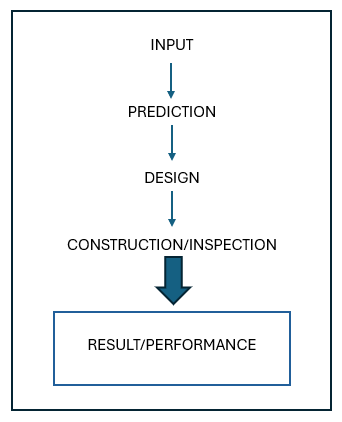
In geoconstruction cases, or other engineered projects, errors, omissions and/or poor workmanship can occur during different stages of the project that can lead to failure or undesirable conditions during the project or even after the project has been completed. The final result in which the case would revolve under may be related to damage to the engineered structure or to excessive unanticipated costs. The points of liability that a project can run into can be summarized into the various main stages of the project which are shown in Figure 1.
The first stage of the project is collecting the relevant information on the project. This can become a liability when the data collected is inaccurate, or incomplete. This can in turn throw off your prediction of what is necessary for design or anticipated effort to construct the project. On a geoconstruction project, an example of this would be differing site conditions which is not discovered until construction or after construction that has impacted the project. An MEA example was when a differing condition remained undisclosed until after a cofferdam failure (UPDATE 57). This is also inherently a problem in design-build projects (Blog link).
Once the relevant project data is collected, a prediction tool(s) is used to assess the requirements of the engineered system. Assuming the project data is appropriate, the design depends on the prediction tool(s) used. Therefore a design defect would result, for example on a geoconstruction site when a governing earth stability analysis was not performed or performed correctly. An MEA example is a the prediction of the deep foundation performance was wrong. This misjudgment resulted in significant damage after construction from upheaval of the deep foundation due to unanticipated claystone rock behavior (UPDATE 37).
The prediction results define the necessary elements of the design which is put in a set of plans and specifications (i.e., the design). The plans and specifications which can contain errors or omissions from inappropriate project input or defective engineering analysis (prediction), but can also include drawing errors and specification ambiguities or defects (ie, defective design). An example of a MEA case involving latent ambiguity case was related to the pay item for hard excavation in the contract specifications (UPDATE 9).
The plans and specifications are used to construct the intended engineered system. Assuming the plans and specifications are appropriate, a construction defect(s) can also result in unsatisfactory performance. This can result from poor workmanship and/or inadequate or inappropriate inspection measures. An MEA example of this was a catastrophic in-mine dam failure where the weak mine floor materials were not removed below the dam (UPDATE 43).
Finding the appropriate geotechnical engineering expert can be difficult decision for an attorney or the less technically adept given the multiple qualifications which are necessary. Probably the most difficult aspect to assess is the engineering capability of the expert. Moreover, the more serious the case, the more effort is typically invested in selecting the geotechnical engineering expert. There are four main avenues that are taken to find a geotechnical engineering expert:
1. Expert recruitment firms,
2. Expert listing sites,
3. Word of mouth references, and
4. On-line research.
Expert recruitment firms provide an expert candidate(s) for the specified need of a case. These firms have a database of experts from which they select who they deem the most appropriate. They then contact the candidate(s) to determine interest and the expert’s knowledge and experience for that particular case. If the candidate is interested and deemed qualified, the expert is referred to the potential client for an interview. The list of experts maintained by the recruitment firm is screened by the firm to varying degrees and is a good question to ask how this list was built and maintained. These firms profit typically by adding a surcharge to the expert’s fees.
Expert listing sites provide a list of potential candidates who advertise their geotechnical engineering expert services on the site. These experts pay a periodic fee to the listing agency. Therefore, these are essential ads and require more discretion from the inquiring party, however, the charged fees are directly from the expert and thus not surcharged as above.
Word of mouth referrals have been utilized since time immemorial. Probably the best geotechnical engineering expert referrals are obtained from a recommendation(s) from a respected expert witness(s) that has worked with that expert geotechnical engineer. Such expert referrals should come from experts in an associated field, such as, a structural engineer, a civil engineer, a construction claims specialist, a mining engineer, or an engineering geologist. Given their familiarity with the field, they provide reference(s) based on the geotechnical engineering expert’s capabilities, and if they have worked with them as an expert witness, their performance in a dispute resolution setting. Another source for a referral used are colleagues that have worked with a geotechnical engineering expert witness. These references would be more based on the expert witness performance aspects and less on technical capabilities of the geotechnical engineering expert.
Another primary method used in selecting a geotechnical engineering expert witness is to perform an individual online search. Such searches result in company ads as well as typical companies which perform such services. Information which can be obtained solely based on such expert witness searches would be related to geotechnical engineering qualifications of company engineer which would likely be evaluated by the non-technical solicitor. This type of search probably provides the least amount of information regarding the individual expert witness performance in dispute resolution settings.
Expert witness qualities to look for fall into three basic categories which are the:
1. Geotechnical engineering capabilities,
2. Expert witness performance as discussed above, and
3. Expert witness integrity.
With respect to the technical capabilities, the geotechnical expert witness should be evaluated as to whether the candidate has sufficient experience in the known aspects of the subject case, but also other potential case issues, because often times, forensic investigations reveal other geotechnical issues which heretofore were unknown. Consequently, a geotechnical expert with a wider experience perspective and base should be preferred. A more specialized geotechnical engineering expert may otherwise missed unrealized aspects of the case.
With respect to geotechnical expert witness performance, the main qualities to look for are the experts verbal and written communication skills, dispute resolution experience, and educator qualities. It is also important to assess the expert geotechnical engineer’s integrity. For example, in the past has the expert performed scientifically sound investigations which hold up under cross-examination: Has this potential geotechnical expert witness been excluded from testifying as a result of a Daubert challenge? This quality becomes increasingly an issue with the strength and amount of cross-examination or resistance which is usually proportional to the size of the case.
When interviewing a potential geotechnical engineering expert, it should be done on a Zoom or similar platform. Have the geotechnical expert explain to you some of their more important cases he/she have been involved with. This is an opportunity to evaluate the expert’s communication skills and whether or not the expert can explain complex matters to conceptual understanding to you. Avoid those that appear to “give you the opinions you want” without having examined any significant project information. Where more “high profile” cases are involved, ask the geotechnical expert about the size of the cases he/she has been involved in. It is important that your expert geotechnical engineer has the experience to handle the potential level of scrutiny that he/she will be under in such cases.
Another decision which must be made is whether the expert fees are reasonable for the forensic investigation. Keep in mind that geotechnical experts, especially in larger cases, will use associates or staff to perform certain tasks. This can be a cost-effective approach when their fee rates are lower. Because of the nature of forensic investigation, it is difficult to rely on a lump sum estimate. The ultimate costs will be dependent upon the expert geotechnical engineer’s judgement of effort which is necessary given the nature of the case as it becomes apparent. Given the geotechnical engineering expert’s qualifications and experience their fee rate can be evaluated by comparing it to others with similar qualifications. This can be done by comparing rates of similar experts based on your and others with the appropriate knowledge base.

 MEA example was when a differing condition remained undisclosed until after a cofferdam failure (UPDATE 57). This is also inherently a problem in design-build projects (Blog link).
