
Guidelines of Areas of Liability in Geoconstruction Cases
In geoconstruction cases, or other engineered projects, errors, omissions and/or poor workmanship can occur during different stages of the project that can lead to failure or undesirable conditions during the project or even after the project has been completed. The final result in which the case would revolve under may be related to damage to the engineered structure or to excessive unanticipated costs. The points of liability that a project can run into can be summarized into the various main stages of the project which are shown in Figure 1.
The first stage of the project is collecting the relevant information on the project. This can become a liability when the data collected is inaccurate, or incomplete. This can in turn throw off your prediction of what is necessary for design or anticipated effort to construct the project. On a geoconstruction project, an example of this would be differing site conditions which is not discovered until construction or after construction that has impacted the project. An 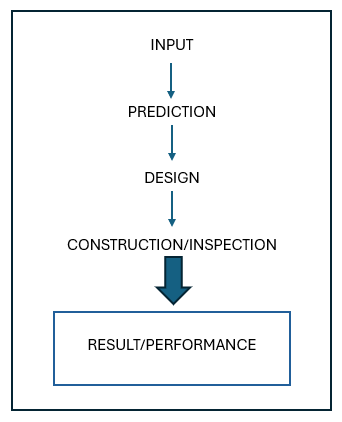 MEA example was when a differing condition remained undisclosed until after a cofferdam failure (UPDATE 57). This is also inherently a problem in design-build projects (Blog link).
Once the relevant project data is collected, a prediction tool(s) is used to assess the requirements of the engineered system. Assuming the project data is appropriate, the design depends on the prediction tool(s) used. Therefore a design defect would result, for example on a geoconstruction site when a governing earth stability analysis was not performed or performed correctly. An MEA example is a the prediction of the deep foundation performance was wrong. This misjudgment resulted in significant damage after construction from upheaval of the deep foundation due to unanticipated claystone rock behavior (UPDATE 37).
The prediction results define the necessary elements of the design which is put in a set of plans and specifications (i.e., the design). The plans and specifications which can contain errors or omissions from inappropriate project input or defective engineering analysis (prediction), but can also include drawing errors and specification ambiguities or defects (ie, defective design). An example of a MEA case involving latent ambiguity case was related to the pay item for hard excavation in the contract specifications (UPDATE 9).
The plans and specifications are used to construct the intended engineered system. Assuming the plans and specifications are appropriate, a construction defect(s) can also result in unsatisfactory performance. This can result from poor workmanship and/or inadequate or inappropriate inspection measures. An MEA example of this was a catastrophic in-mine dam failure where the weak mine floor materials were not removed below the dam (UPDATE 43).